TEL: 86-21-33558538
Email: uv@awellcure.com

TEL: 86-21-33558538
Email: uv@awellcure.com
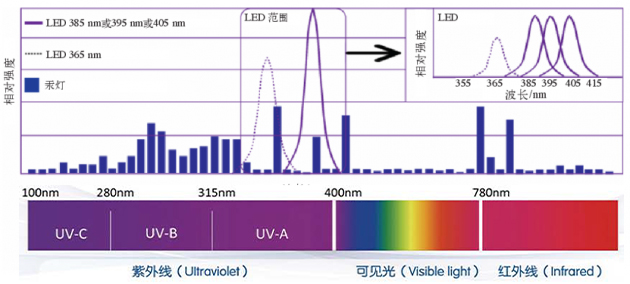
According to the wavelength, UV light can usually be divided into three bands: UVC (100-280nm), UVB (280-315nm) and UVA (315-400nm), as shown in Figure 1. The UV light emitted by traditional mercury lamps covers all three bands, and can be doped with different means (iron, gallium, etc.) to make the spectrum have different intensities in different bands or specific wavelengths, so as to meet different curing application requirements.
Figure 1 Comparison of UV spectrum and emission spectra of mercury lamp and LED lamp
The emergence of UV LED technology has brought new development opportunities for radiation curing technology. UV LED light sources are solid light sources and do not use harmful substances such as
mercury. UV LED light sources have many advantages, such as no need for preheating time, instant use, no mercury pollution, relatively small equipment size, more energy-saving, longer service life (up to tens
of thousands of hours), no ozone generation, and no air pollution to the use environment. In addition, there is no infrared part in the emitted light, which can be used for heat-sensitive substrates.
These advantages have accelerated the application and promotion of UV LED in the current environment of energy saving, environmental protection and VOC control, so it has been rapidly developed and
popularized in the past 10 years. UV LED curing has replaced traditional mercury lamp curing and become the mainstream in many application fields such as adhesives and inks.
The most common UV light-curing products are UV coatings, UV inks and UV adhesives, with fast curing rates, generally between a few seconds and tens of seconds; they can be applied to a variety of
substrates, such as paper, wood, plastic, metal, leather, stone, glass, ceramics, etc., especially for some heat-sensitive materials (such as paper, plastic or electronic components, etc.).
The light source parameters of UV curing include output wavelength distribution, irradiation intensity, irradiation area, etc. Existing standards related to light curing are mostly based on the traditional mercury
lamp light source system, and there are few light curing technology standards implemented with UV LED light sources.
At present, the curing market is the main application of UV LED, and the acceptance of various segments is increasing. The market penetration rate of UV LED in the field of radiation curing is about 10%-20%;
among them, surface curing is dominant in the UV LED curing market, about 90%, and point-shaped UV LED irradiation curing is mainly used in UV bonding. Linear UV LED irradiation curing is less used due to
the low irradiation energy density of the light source.
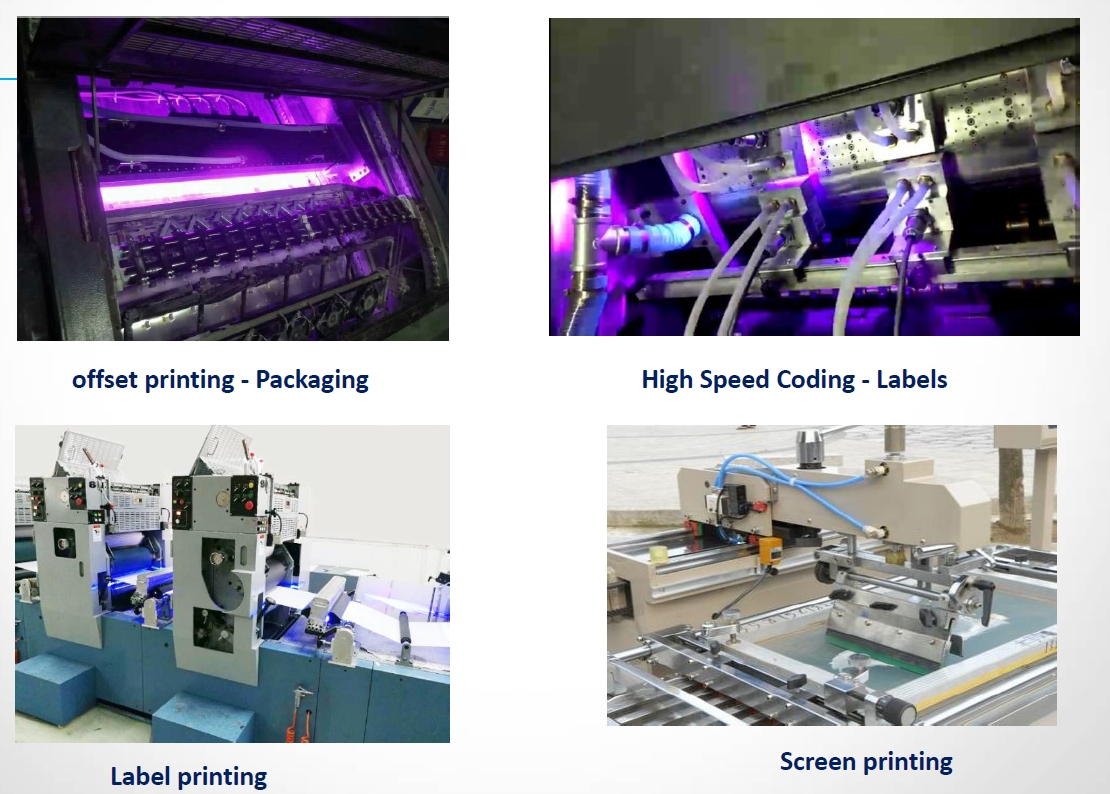
In the field of ink curing, the printing curing on the market mainly adopts UV LED with wavelengths of 365 nm, 385 nm, and 395 nm. At present, UV LED light sources have shown different degrees of
penetration in the fields of exposure curing, inkjet printing, screen printing curing, offset printing curing, etc. It has basically replaced mercury lamps in printed circuit exposure and inkjet curing and has been widely used In the fields of offset printing and screen printing, the replacement rate of UV curing light sources is less than 20%.