TEL: 86-21-33558538
Email: uv@awellcure.com

TEL: 86-21-33558538
Email: uv@awellcure.com
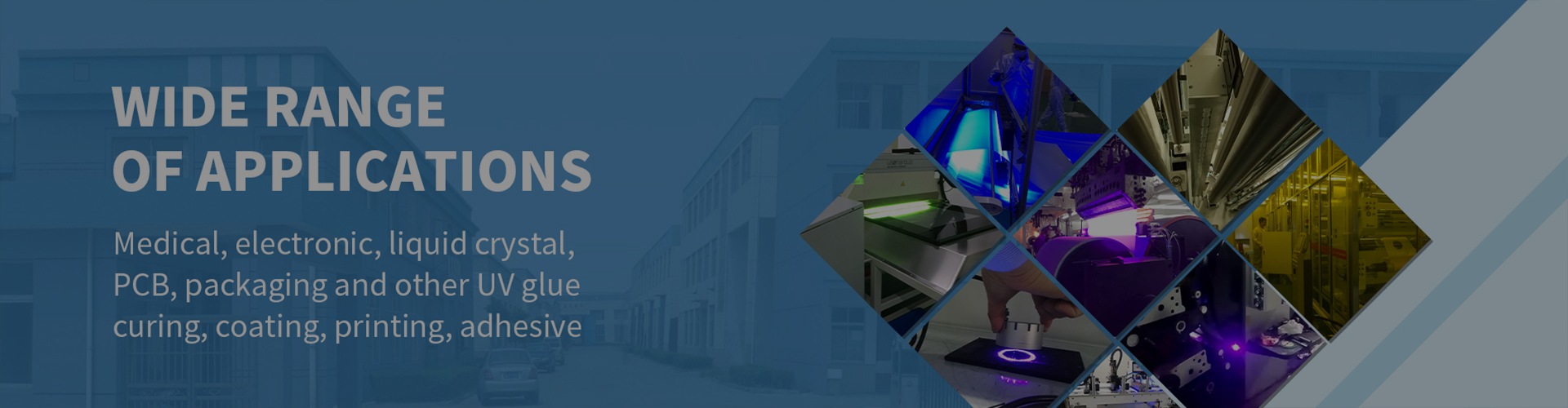
UV LED Curing technology, which utilizes ultraviolet light to cure coatings, has rapidly developed over the past few decades as a green, environmentally friendly, and efficient technology. The basic principle of UV curing involves the irradiation of ultraviolet light, which is absorbed by a photoinitiator at a specific wavelength. This absorption generates free radicals or cations, initiating the polymerization and cross-linking reactions of monomers and oligomers. As a result, a high molecular polymer with a network structure is formed in a very short time, effectively achieving curing.
Currently, the traditional medium-pressure uv mercury lamp (referred to as a high-pressure mercury lamp in China) is commonly used as a UV curing light source, still holding more than half of the market share today. The strongest emission wavelength of these lamps is 365 nm, with additional emissions around 254 nm and between 208-331 nm. However, mercury lamps have several drawbacks: 1. Short service life, typically between 1,000 and 2,000 hours. 2. Gradual decay of light intensity, which affects the control of the curing effect. 3. High energy consumption and significant heat generation; they also require a long startup time and need to preheat. 4. Large size, making them difficult to install in spaces with limited room. A significant drawback is their reliance on mercury, a substance harmful to the environment. This limitation persisted until the advent of UV LED technology, which has since shown a clear trend of replacing traditional methods in the light curing industry. The introduction of UV LED technology has opened new development opportunities for radiation curing. UV LED light sources are solid-state and do not contain harmful substances such as mercury. They offer numerous advantages, including: - No preheating time, allowing for immediate use. - No mercury pollution and less environmental impact. - Compact equipment size and greater energy efficiency. - Longer service life, often lasting tens of thousands of hours. - No ozone generation or air pollution in the work environment. - Absence of infrared light in the emitted spectrum, making them suitable for heat-sensitive substrates. These benefits have accelerated the adoption and promotion of UV LEDs, particularly in the context of energy conservation, environmental protection, and VOC control. Consequently, UV LED curing has rapidly developed and become the mainstream choice in various application fields, including adhesives and inks over the past decade. The most common UV light-curing products include UV coatings, UV inks, and UV adhesives, which cure quickly—typically within seconds to tens of seconds. These products can be applied to a wide range of substrates, including paper, wood, plastic, metal, leather, stone, glass, and ceramics, making them especially suitable for heat-sensitive materials like paper, plastic, or electronic components.
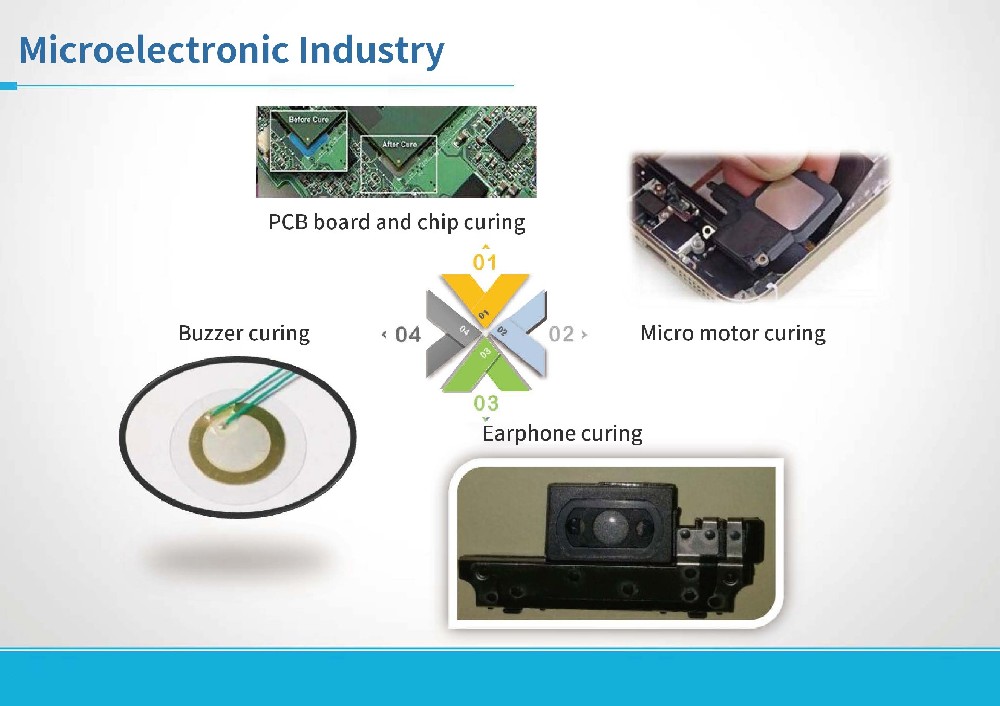
Microelectronics Industry
Mobile phone component assembly: including curing of camera lenses, receivers, microphones, housings, LCD modules, touch screen coatings, etc.
Hard disk head assembly: such as gold wire fixing, bearings, coils, chip bonding, etc.
DVD/digital camera manufacturing: used for lenses, lens bonding, circuit board reinforcement, etc.
Motor and component assembly: involving wire, coil fixing, PTC/NTC component bonding, protection transformer core, etc.
Semiconductor chip manufacturing: including moisture-proof protective coating, wafer mask, wafer contamination inspection, UV tape exposure, wafer polishing inspection, etc.
Sensor production: used for gas sensors, photoelectric sensors, fiber optic sensors, photoelectric encoders, etc.