TEL: 86-21-33558538
Email: uv@awellcure.com

TEL: 86-21-33558538
Email: uv@awellcure.com
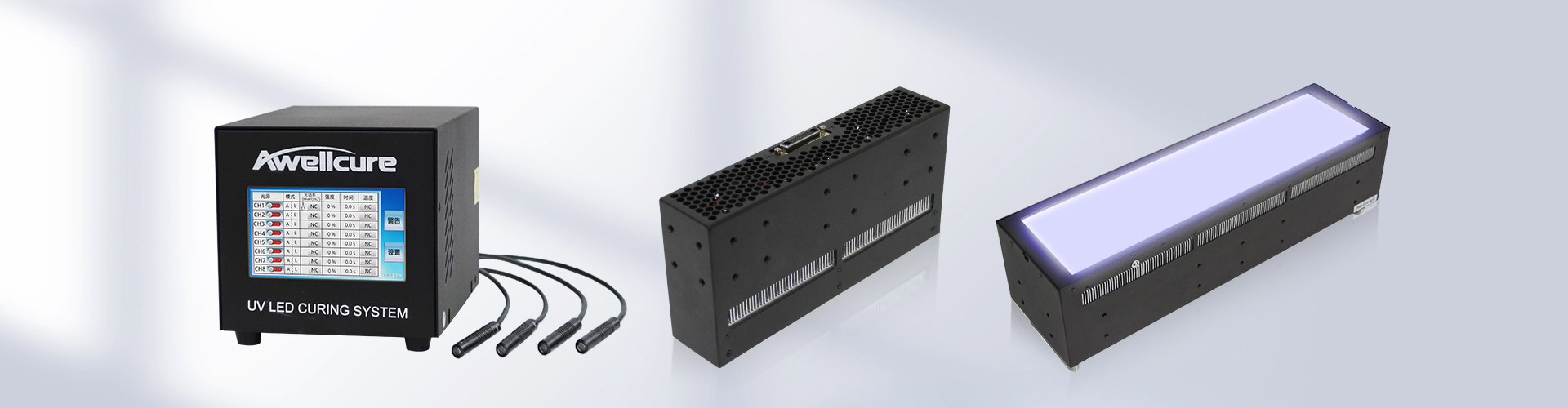
Awellcure Spot UV Curing System is used Japanese aspherical lens with high-transmittance quartz material.
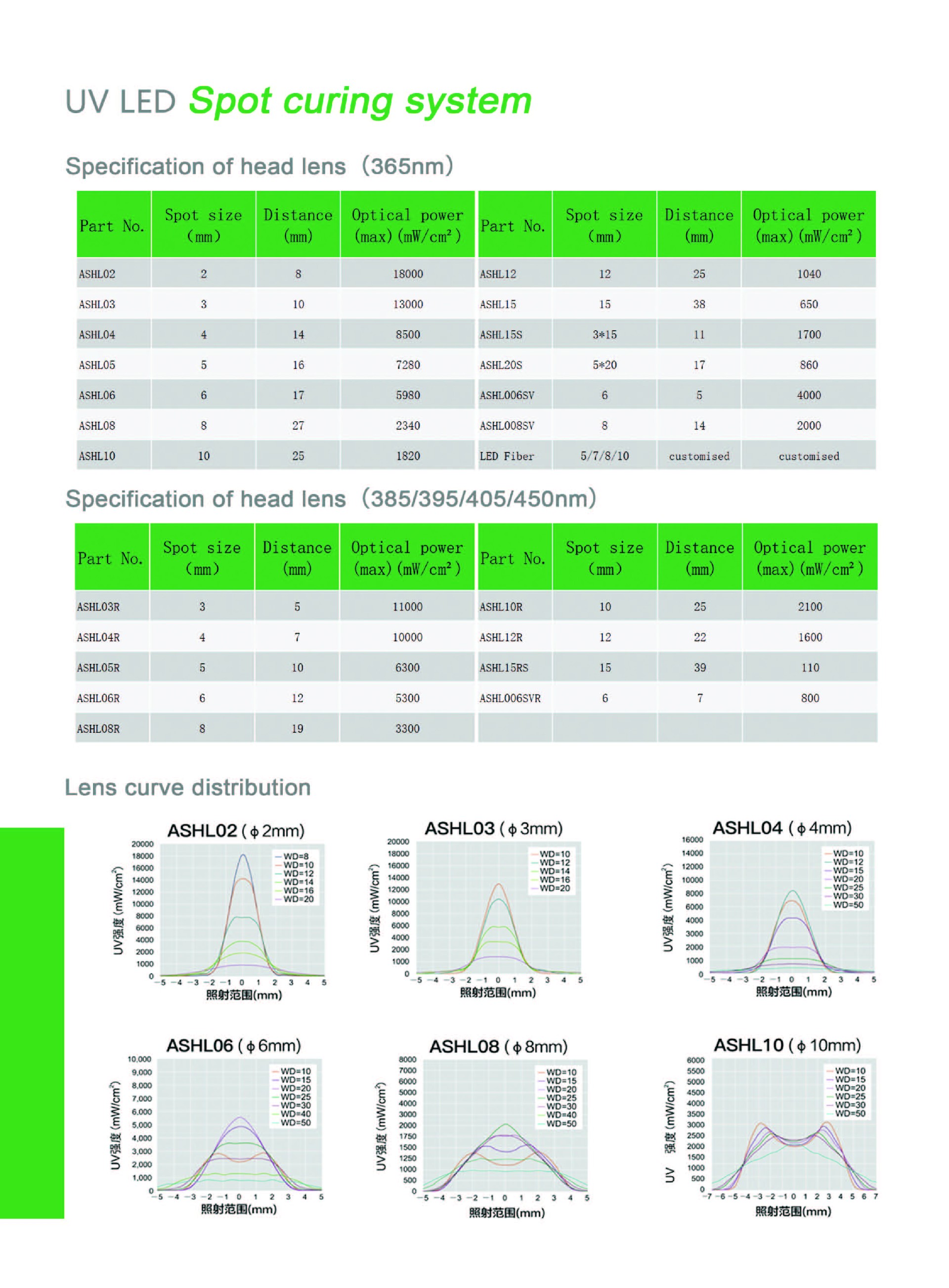
The industry's highest output light head with 18000mw/cm2.
Awellcure LED Spot Type UV Curing Machine has following features.
Feature 1: Simple operation interface, easy to understand quick operation.
Feature 2: Independent control of 4 channels or 8 channels LED light heads, independent control of each LED light heads, and more channels can be customized, and the irradiation power, time, and irradiation time of each LED light head can be controlled separately.
Feature 3: Portable and simple installation.
Smallest controller design of built-in power supply in uv led curing industry.
Feature 4: Safer and more stable: signal control terminals are made in Japan.
Feature 5: External access control and signal output
Control UV irradiation from external input signals, and automatic control can be achieved on the production line. Signals can be sent from external devices such as programmable controllers to control the UV irradiation time of LED light heads.
By operating the controller, the UV irradiation time of each LED light head can be set in units of 0.1 seconds, and the irradiation can be started and ended according to the external signal, or UV irradiation can be performed only during the duration of the signal, etc., to achieve a variety of controls.
Each controller is equipped with an abnormal alarm signal for the LED light head, and also realizes the output signal of the working status, which is convenient for the related automation equipment to carry out the next step.
Feature 6: Temperature feedback constant illumination mode
The irradiation accuracy is within ±3%. (When the output is 80%) Usually, after the LED temperature rises, the output of the irradiated UV will decrease. In the LED light head, a special metal heat sink structure with very high heat dissipation is used to suppress the temperature rise. The LED light head has a built-in temperature sensor, which always monitors the temperature and provides feedback. When the output is 80%, the accuracy is within ±3%, achieving excellent UV irradiation stability. Most suitable for high-quality and precise bonding purposes.
Feature 7: Anti-fool setting
The interface key has a function to lock the setting parameters, and can also lock the working status of the controller to prevent the operator from terminating the irradiation prematurely and prevent insufficient irradiation.
Feature 8: Step irradiation function
Suppress hardening deformation and achieve high-quality and high-precision bonding.A variety of step modes and pulse modes can be set to suppress hardening deformation.
Feature 9: Adopts a fully aluminum enclosed housing to avoid dust and rust.
Feature 10: Records the service life of LED light heads
Records the lighting time of each LED light head and reminds the replacement period according to the cumulative lighting time of the LED light head, or issue a temperature abnormality warning.
Features of UV LED Light Head
Feature 1: The light head uses aspheric lenses to achieve the industry's highest output light power of 18W/cm^2.
Feature 2: The use of aspheric lenses makes the uniformity of the irradiated light spot the best.
Feature 3: The irradiated light spot can be selected from 2/3/4/5/6/7/8/10/12/15 and special linear lenses and side lenses. The number of available varieties is: the first in the industry.
Feature 4: The core materials of the light head are all made of well-known brands: NICHIA high-level LED + DowCorning + HOYA quartz lenses.
Feature 5: The connection cable between the light head and the controller uses imported robot resistant bending cables, and the tip uses Japanese Sun Robot resistant bending cables (guaranteed to withstand bending at R30mm for 1000w times).
Feature 6: The standard connection cable is 2m, and special 5m or longer can be customized.
Feature 7: Using the LED method, there is no need to frequently replace equipment, and the estimated service life of the LED light head is 20,000H.